
With summer around the corner and the sun finally making its way out of the clouds, its time to dig out that suncream that has been hiding in your drawer all winter. Although most of us are eager and excited to finally sit outside and chase that bronzed summer glow, there’s a lot happening beneath the surface of our skin that is easy to overlook. That golden tan you are chasing? It’s actually a sign of sun damage. Granted, I love a tan and a beach day as much as the next, but what I don’t know is how its affecting me and my health.
The tanning and the “healthy” glow you see from a day under the sun is actually the result of ultra violet (UV) radiation, and excessive and continuous exposure can result in skin ageing, pigmentation and increased cancer risk. So how do we enjoy the summer sun and stay safe at the same time? Well the short answer is to always apply Sun Protection Factor (SPF). However, not all SPF is created equal, and not all works the same, which is why its important to understand what the numbers on the labels mean, and how they actually work.
UVA vs UVB
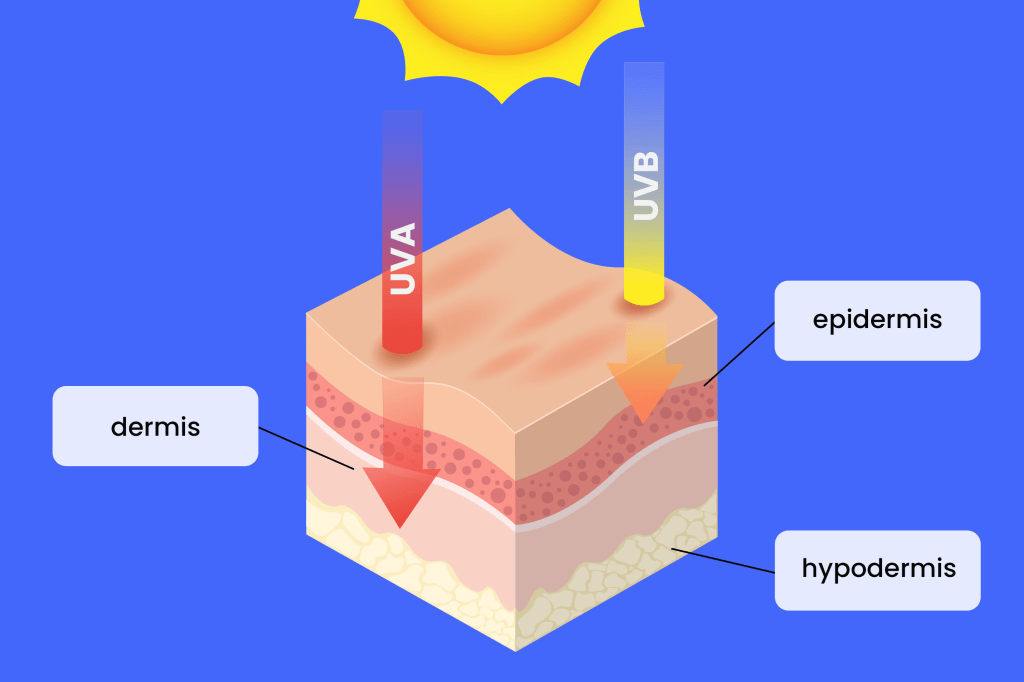
Ultra violet radiation comes in two main forms UVA and UVB rays. UVA rays are the “ageing” rays, and make-up 95% of all UV radiation that reaches earth’s surface. These rays are the ones that penetrate deep into your skin and cause wrinkles, fine lines, sun spots and general ageing-related symptoms. UVA rays can penetrate glass, and because they can reach the dermis of your skin, they may also contribute to skin cancers. UVB rays, on the other hand, are “burning” rays and are those that cause the sun burn or golden tan that you see under the sun. These have a smaller wavelength (at around 280-320nm), and while they cannot penetrate glass and reach only the epidermis, they are still the major contributors of DNA damage and skin cancers.
SPF, how does it actually work?
So now that we’ve understood that sunlight can come in two major forms of UV rays (A and B), the question is how does sunscreen or SPF actually protect us from these rays and prevent those negative consequences? Well, at the molecular level sunscreen utilised active ingredients that can either absorb the UV radiation and convert it into harmless heat, or physically block and scatter the rays. Organic or chemical filters, are active agents that absorbs the UV radiation, such as Avobenzone that absorbs UVA rays, Octinoxate that absorbs UVB, and Oxybenzone that absorbs both. Essentially, when you apply sunscreen onto your skin it creates a protective layer that acts like a UV shield. The active ingredients in the chemical sunscreens absorb the UV rays, and when the UV photon hits one of these molecules it excited the molecule into a high energy state. To get rid of this excess energy safely, the molecules releases it as low-energy heat, which is harmless. Once the molecule “calms down” and returns to its ground state, it can get ready to absorb another photon and repeat the process, helping to continuously guard your skin from UV damage.
Physical or inorganic filters, on the other hand, are developed to reflect and scatter UV rays. Zinc oxide, or titanium oxides are examples of this type of SPF protection. They work by forming a protective mineral layer on the skins surface, so that when the UV rays hit your skin, they easily reflect off or scatter themselves. So whats the difference between Chemical and Physical Sunscreen protection, and when would I have to use which? Well the short answer is if you want a lightweight and invisible finish, or if you’re swimming and exercising a lot then the chemical sunscreen is best. If you have sensitive or acne prone skin or are using it to protect a baby or toddler then Physical sunscreen is better. Physical sunscreen is also reef-safe and eco-friendly, but some may not cover UVA rays.

Can I still tan with sunscreen?
Now that we know and understand the science behind UV rays and SPF protection, the question on everyone’s mind is, but will I still tan with sunscreen on? I don’t know where this myth came from, maybe its the fact that when you burn and turn red, it turns quite dark afterwards, so people assume that its more effective tanning. But in reality, that redness and then “tan” that you see after you burn is not a healthy tan, but rather a response to injury. The redness is the inflammatory pigmentation from the sun exposure, not the melanin production. When this happens, the UVB rays can trigger cell death, which can result in the peeling and dead-skin shedding off. This then removes the pigment away anyways, and often leaves you blotchy and uneven and overtime can cause hyperpigmentation, especially on lighter skin. “But it turns tan after a few days Alice”. You’re correct, as your skin tries to heal and protect itself from further damage it ramps up melanin production, since melanin absorbs UV rays, in an attempt to prevent further DNA damage. So while you make look nice and tan, you’re body is actually trying to stop you from damaging your DNA. Now to be clear, I’ve laid in the sun for hours for the purpose of tanning too, but if you want an honest and safe tan with gradual melanin build up you need to wear sunscreen, and reapply it often! Because sunscreen doesn’t block UV rays completely — especially UVA rays, which are the main drivers of tanning — your skin can still darken gradually even with SPF. And that’s the best way to get that glow — safely, healthily, and in a way that lasts over time without damaging your skin.

 ALICE EXPLAINS
Leave a comment