My hair has always been a big part of who I am. I have thick, voluminous, curly brown hair that, growing up, was often more frizzy than princess-Merida-like. My mum, on the other hand, has thin, straight blonde hair – so I guess I get the curls from my dad. I was never embarrassed of my hair, but I did sometimes wish it were straight. Not because I didn’t like my curls, but because straight hair seemed so much easier. Mine felt tangled, unpredictable, and difficult to manage in comparison.
As I got older – especially during the Covid pandemic when TikTok took off – I found myself deep in the world of hair tutorials. Suddenly, there were thousands of girls with hair like mine, all sharing routines, rules, and “must-have” products. “Use a cream, a mousse, and a gel. Scrunch, but not too much. Diffuse, but not on high heat. Dry it 80%, then let the rest air dry.”.
It quickly became overwhelming.
The more I learned about styling my hair, the more it felt like I was just consuming marketing, product recommendations, and personal routines that didn’t necessarily apply to me. Everything was presented as universal, when clearly it wasn’t. So instead of trying another routine, I decided to take a step back and understand my hair properly – what it actually is, how it behaves, and why. Not just through trends, but through biology.
So before we speak about how to find what works for you and how your hair type is lets take a look at something we all have in common: biological rules of hair growth.
Hair structure
Let’s first understand how hair is structured at a cellular level. Each of us has around five million hair follicles across our body, which are responsible for producing each individual hair strand. The hair follicle of shaft is made up of an inner and outer root sheath, and it is the primary structure that controls hair growth.
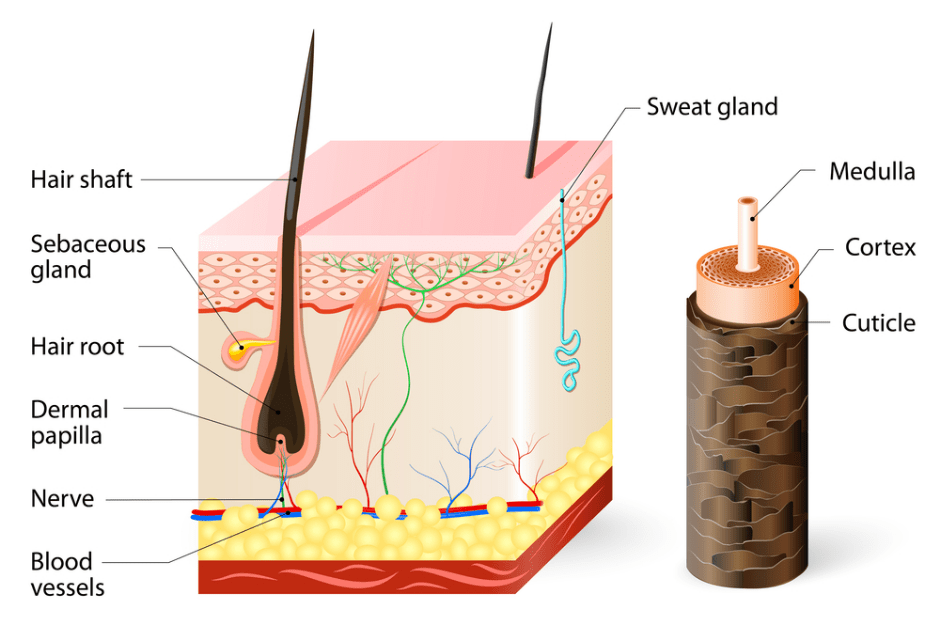
The outer part is made up of a reservoir of stem cells that are able to differentiate into melanocytes and keratinocytes, which help with growth and pigmentation respectively. These cells sit in these reservoirs and regenerate overtime and maintain your hair. The inner sheath helps support the hair strand. It produces proteins that give hair its structure and guides the hair as it grows out of the skin.
At the base of the follicle is the hair root, where hair is actively produced, which is surrounded by the dermal papilla, that supplies nutrients and sends signals that influence how your hair grows, including its thickness, length, and colour. Cells in the root divide rapidly and move upward, gradually forming the hair strand. As the strand grows out of the scalp, it forms the hair shaft, which consists of three main layers: the medulla, cortex, and cuticle.
The medulla is the innermost layer and is not always present, particularly in finer hair. The cortex makes up most of the hair and is responsible for its strength, elasticity, colour, and curl pattern. The cuticle is the outermost layer, made of overlapping cells, and plays a key role in how smooth, shiny, and tangle-free your hair appears.
Curly vs straight hair
So what actually determines whether we have straight or curly hair and why does this even happen? Well, hair shape is largely attributed to genetics, which influence the structure of your hair follicle. Round follicles tend to produce straight hair, while more oval or flattened follicles produce wavy, curly, or coily hair. Curly hair fibres are asymmetrical, meaning one side of the strand differs from the other. This is thought to result from uneven cell division and keratin formation within the hair bulb, causing the strand to bend as it grows rather than forming straight. A helpful way to visualise this is to think of a piece of gift-wrapping ribbon. When you run scissors along one side, you flatten and stretch that side while leaving the other unchanged, causing it to curl. A similar principle applies to hair.
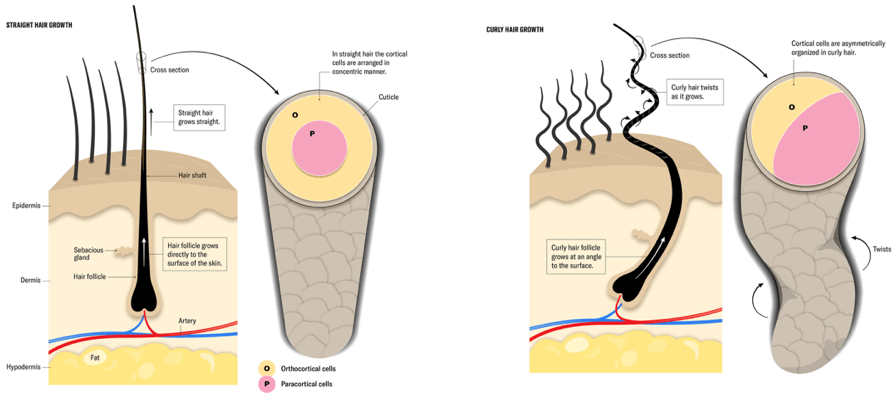
There are also evolutionary theories behind this variation. Tightly curled hair, more common in populations from hotter climates, may help with heat regulation by allowing airflow while still protecting the scalp from sun exposure. However, these are general patterns rather than strict rules, and hair type ultimately exists on a spectrum.
Porosity
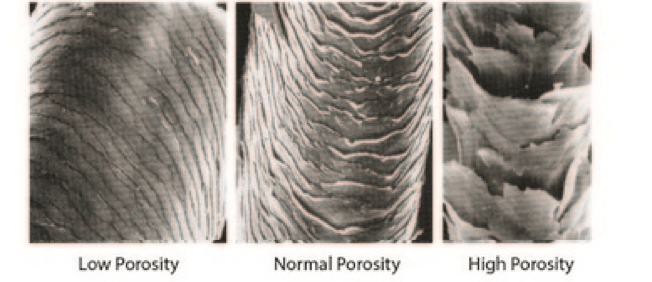
A big part of our hair structure and type is hair porosity, which refers to how well your hair absorbs and retains water and moisture. As mentioned earlier, the cuticle is the outermost layer of the hair strand and has a tile-like structure, with overlapping cells. When these layers lie flat, the hair surface is smooth. When they lift or become damaged, the surface becomes rough and more open.
This directly affects how your hair interacts with water. When the cuticle is more open, water can enter the cortex very quickly, but it also escapes just as fast. The result is hair that often feels dry, frizzy, or difficult to manage, even if you’re conditioning it regularly – this is known as high porosity hair.
On the opposite side of the spectrum, when the cuticle cells are tightly packed and lie very flat, water struggles to enter the hair shaft and often sits on the surface. This can make it feel like your products are coating your hair rather than being absorbed – this is known as low porosity hair.
So what can you actually do about it? The goal is not to change your hair, but to control how water moves in and out of the fibre.
If you have low porosity hair, applying heat (such as warm water or steam [not styling heat!]) can temporarily increase permeability, allowing water and conditioning agents to penetrate more effectively. Smaller, lightweight molecules (like humectants, which attract water) are more likely to enter the fibre, while heavier oils tend to remain on the surface.
In high porosity hair, the focus shifts to reducing water loss. Conditioning agents and oils can form a hydrophobic (water-repelling) layer on the surface, which slows evaporation and reduces friction between strands. Some oils, such as coconut oil, can also penetrate into the fibre and reduce protein loss, helping to maintain the hair’s structural integrity.
Hair bonds
Another key factor that explains how your hair behaves is the bonding within the hair fibre, particularly in the cortex. Hair is made of keratin, held together by different types of bonds. The most relevant for everyday styling are hydrogen bonds, which are weak and easily broken by water. When your hair gets wet, these bonds break, allowing the hair to be reshaped, and as it dries, they reform, setting the hair in that new structure.
Stronger bonds also exist. Salt (ionic) bonds contribute to the hair’s elasticity and are influenced by pH and moisture, while disulfide bonds are much stronger and largely determine your natural curl pattern.
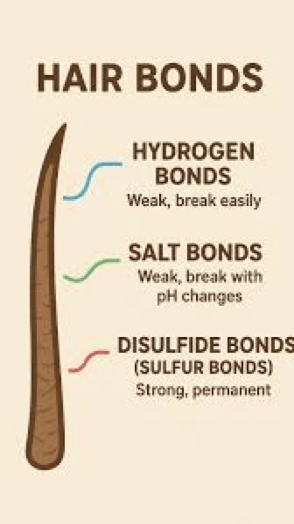
This is where porosity and bonding come together. Porosity controls how easily water enters the fibre, and these bonds determine how the hair sets once that water is inside. In practice, this means that how your hair dries is just as important as what you put on it. If bonds don’t have time to fully reform, or if moisture is uneven, the structure becomes inconsistent – leading to frizz or loss of shape.
This also explains something I’ve noticed myself: my hair looks its best after a day at the beach, even without any product. Salt left on the hair adds structure and increases friction between strands, helping them clump more evenly as the hair dries. Combined with minimal disturbance, this allows bonds to reform more uniformly, resulting in more defined curls.
In practice, this means you can recreate a similar effect by adding light structure and reducing disruption while your hair dries – whether that’s through salt sprays, lightweight styling products, or simply leaving your hair untouched as it sets.
Conclusion
So overall, understanding your hair porosity and type is important, but adapting your routine to it is just as important. For me, I realised that my hair dries quickly, frizzes easily, and doesn’t get greasy in the same way as others – pointing towards higher porosity. Combined with a curly structure, this makes it more sensitive to moisture changes and mechanical stress.
Over the past year, I’ve consistently started oiling my hair before washing, and I’ve seen a clear improvement in both growth and shine. Scientifically, this is likely less about faster growth and more about reduced breakage and better retention of length.
Studies have shown that oils can reduce protein loss from the hair fibre, helping maintain its strength during washing. Hair is most vulnerable when wet, as it swells and becomes weaker, so applying oil beforehand helps limit that damage. Oils also reduce friction between strands, which further decreases breakage over time. So even if the growth rate hasn’t changed, more of the hair is being retained – which is why it appears longer and healthier.
So what can you actually do with all of this?
Instead of copying routines or chasing the “perfect” product, start by understanding your own hair – how it absorbs water, how it holds shape, and how it responds to handling. From there, small changes become much more effective: adjusting how you wash and dry your hair, reducing unnecessary stress, and choosing products based on what your hair actually needs rather than what works for someone else.
Once you understand the structure behind it, your hair stops feeling random – and starts becoming something you can work with.
References
Dias, M.F.R.G. (2015). Hair cosmetics: an overview. International Journal of Trichology, 7(1), pp. 2–15. Available at: https://pmc.ncbi.nlm.nih.gov/articles/PMC4387693/
Loussouarn, G., Garcel, A., Lozano, I., Collaudin, C., Porter, C., Panhard, S., Saint-Léger, D. and de La Mettrie, R. (2007). Worldwide diversity of hair curliness: a new method of assessment. International Journal of Dermatology, 46(s1), pp. 2–6. Available at: https://pubmed.ncbi.nlm.nih.gov/17728935/
Rele, A.S. and Mohile, R.B. (2003). Effect of mineral oil, sunflower oil, and coconut oil on prevention of hair damage. Journal of Cosmetic Science, 54(2), pp. 175–192. Available at: https://pubmed.ncbi.nlm.nih.gov/12715094/
Robbins, C.R. (2012). Chemical and Physical Behavior of Human Hair. 5th ed. Berlin: Springer. Available at: https://www.sciencedirect.com/book/9783642256103/chemical-and-physical-behavior-of-human-hair
Trüeb, R.M. (2017). Hair. In: StatPearls. Treasure Island (FL): StatPearls Publishing. Available at: https://www.ncbi.nlm.nih.gov/books/NBK499948/
Wortmann, F.J. and Sendelbach, G. (2005). Keratin structure and hair fibre properties. International Journal of Cosmetic Science, 27(5), pp. 261–268. Available at: https://pubmed.ncbi.nlm.nih.gov/16258695/
Image Sources
Paramount Beauty (n.d.). Learn the science of curly hair. Available at: https://www.paramountbeauty.com/blog/for_you/learn_the_science_of_curly_hair
Scientific American (n.d.). Untangling the mysteries of curly hair. Available at: https://www.scientificamerican.com/custom-media/loreal/untangling-the-mysteries-of-curly-hair/
Curls and Beauty Diary (n.d.). Hair porosity explained. Available at: https://www.curlsandbeautydiary.com/everything-wanted-know-hair-porosity/
 ALICE EXPLAINS
Leave a comment